
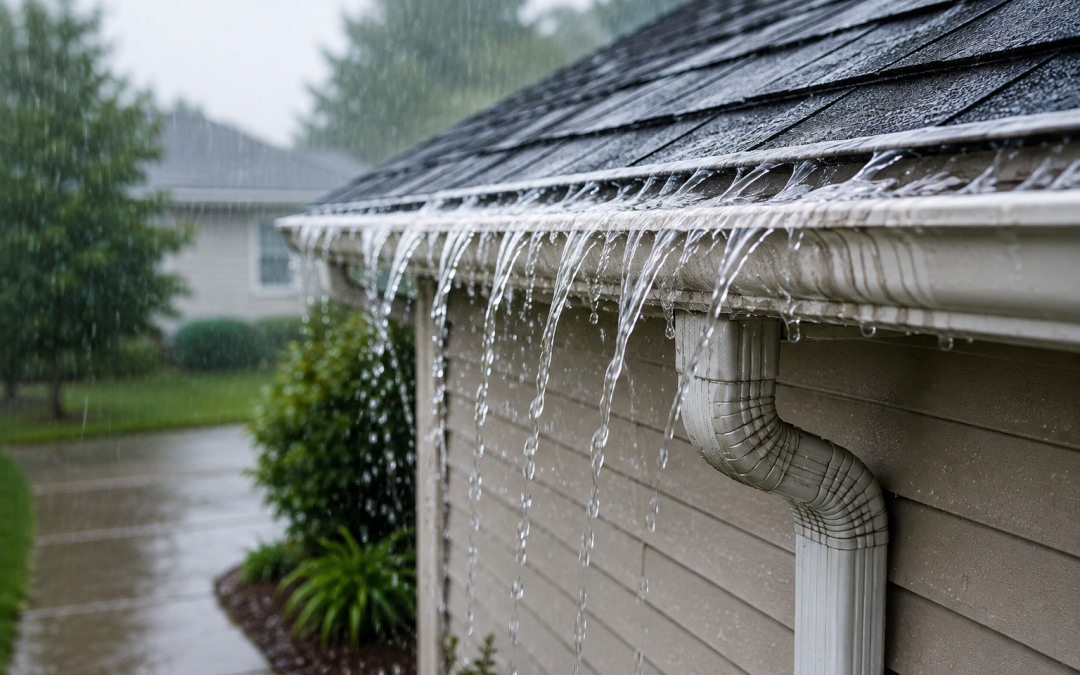
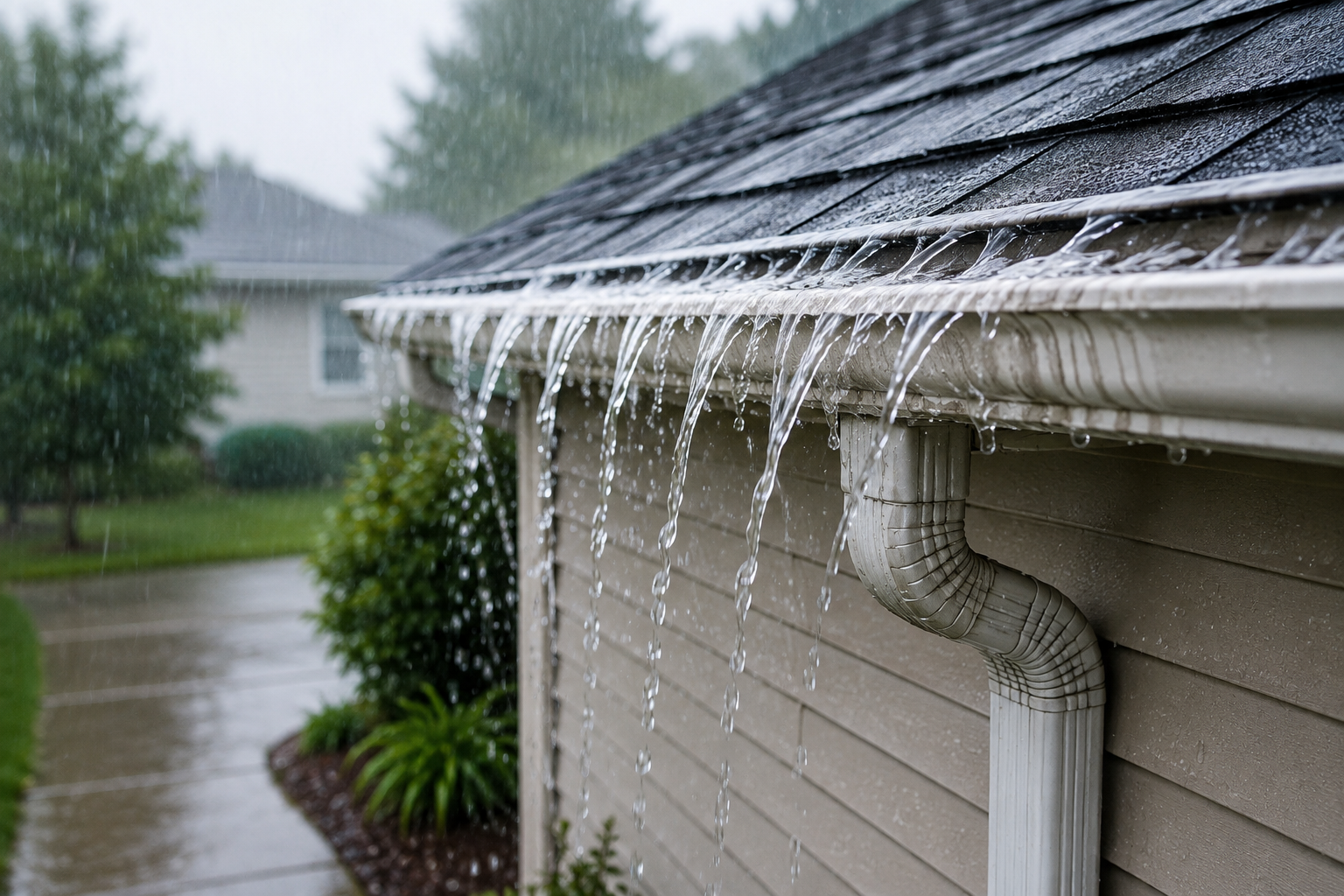
Picture this: it’s the middle of a Florida downpour, and instead of your gutters quietly doing their job, water is sheeting over the edge like a mini waterfall — right onto your flower beds, your siding, or the walkway you just power-washed last month.
It’s easy to shrug off. But that overflow isn’t just annoying to watch — it’s your gutter system waving a red flag. Gutters exist for one reason: to catch rainwater and steer it safely away from your home. When they can’t keep up, the fallout shows up in places you’d rather it didn’t — soaked fascia boards, stained siding, eroded landscaping, and water pooling right where your foundation doesn’t want it.
Sometimes the fix is small. Other times, overflow is a sign that the gutter system was never quite matched to how much water your roof actually sheds. Here’s what’s usually behind it — and what actually fixes it.
1. Your Gutters Might Just Be Too Small
Not all gutters are built to handle the same workload. Roof size, roof pitch, the number of roof sections, and how hard it rains in your area all factor into how much water a gutter system needs to move.
That last part matters a lot here — Central Florida doesn’t do gentle drizzle. When a storm rolls through, it can dump a serious volume of water onto your roof in a short window, and undersized gutters simply run out of room.
If your gutters overflow like clockwork every time a heavy storm hits — even though they’re otherwise in good shape — the size of the system itself may be the real issue. Upsizing the gutters or boosting overall drainage capacity is often the fix.
2. There Aren’t Enough Downspouts
Think of gutters as the collection system and downspouts as the exit ramps. If there aren’t enough exit ramps, traffic backs up.
A long stretch of gutter with too few downspouts fills faster than it can drain. Once it hits capacity, water has nowhere to go but over the side. This is especially common on larger homes or houses with complex rooflines, where a single downspout is being asked to do the work of two or three.
Getting downspout placement — and quantity — right is just as important as getting the gutter size right.
3. The Slope Is Off
Here’s something most homeowners don’t realize: gutters aren’t supposed to be perfectly level. They need a subtle, deliberate slope toward the downspouts — one you shouldn’t even be able to notice by eye.
If a gutter is installed dead level, or worse, tilted the wrong direction, water just sits there instead of flowing where it should. Too much slope creates its own problems too — it can look visibly crooked and send water rushing toward one end faster than the system can handle.
Getting that pitch exactly right — enough to move water, not enough to be noticeable — is one of the more technical parts of a proper gutter installation.
4. Roof Valleys Are Overloading One Section
A roof valley is where two roof slopes meet and funnel water together — and during a hard rain, that means two sections’ worth of runoff converging into one relatively narrow channel.
That’s a lot of pressure on a small stretch of gutter. If overflow always seems to happen in the exact same spot — right below a valley — the rest of your gutter system might be perfectly fine. The problem is localized: that one section may need a larger gutter, a repositioned downspout, or a redesigned outlet to keep up with the surge.
5. Your Gutters Are Sagging or Pulling Away
Gutters rely on secure hangers to stay snug against the fascia and hold their slope. When hangers loosen or fail over time, sections start to sag — and sagging gutters create low points where water pools instead of draining.
Eventually, those pooling spots overflow, even if the rest of the system is working fine.
The good news: minor sagging is often a quick repair — tightening or replacing hangers and restoring the proper pitch. But if the gutters are badly bent, pulling away from rotted fascia, or have been sagging long enough to cause real damage, you’re looking at a more involved repair or a full replacement.
6. The Downspout Can’t Drain Fast Enough
Having downspouts isn’t the same as having the right downspouts. If they’re undersized or poorly placed, they create a bottleneck — water piles into the gutter faster than the downspout can carry it away, and the gutter overflows before it even reaches its supposed exit.
Where that water lands matters too. A well-designed system doesn’t just move water out of the gutter — it carries it well away from your foundation, not into a puddle that seeps right back toward your home.
7. The Gutters Were Never Positioned Correctly
Even a perfectly sized, perfectly pitched gutter can fail if it’s mounted in the wrong spot. Too low, too far from the roof edge, or misaligned with the drip edge, and fast-moving rainwater can shoot right past the gutter — or sneak in behind it.
From the ground, that can look exactly like overflow. But the real issue isn’t capacity — it’s placement. And no amount of cleaning or hanger-tightening will fix a gutter that was never mounted where it needed to be.
Why You Shouldn’t Just Shrug This Off
A little splashing over the edge might not seem like a big deal in the moment. But overflow that keeps happening, storm after storm, adds up — fascia and soffits soak and eventually rot, landscaping gets washed out, siding stains, walkways puddle, and the soil around your foundation stays saturated far longer than it should.
A gutter system’s job isn’t just to collect rainwater. It’s to control where that water ends up. When it’s not doing that, something downstream of “just clean the gutters” usually needs attention.
Do Overflowing Gutters Always Mean Replacement?
Not necessarily — and that’s good news.
If your gutters are structurally sound, the fix might be as simple as correcting the slope, securing loose sections, adding or repositioning downspouts, or upgrading drainage capacity in one trouble spot.
Replacement makes more sense when the gutters are significantly damaged, undersized for the home, repeatedly separating from the fascia, leaking extensively, or were simply never designed right for the property in the first place.
The honest answer usually requires a real look at the system — which is where a professional inspection earns its keep.
Dealing With Overflowing Gutters in Deltona?
At Deltona Gutter Installers, we don’t just look at the spot where water happens to be spilling over. We evaluate the whole picture — roofline, gutter size and slope, downspout placement, roof valleys, and how much water your property actually needs to move during a real Florida storm.
If your current gutters aren’t cutting it, we’ll recommend a solution — repair or full installation — built for how your home actually sheds water, not a one-size-fits-all fix.
Contact Deltona Gutter Installers today to get your gutter system evaluated and stop the overflow before the next storm rolls in.